
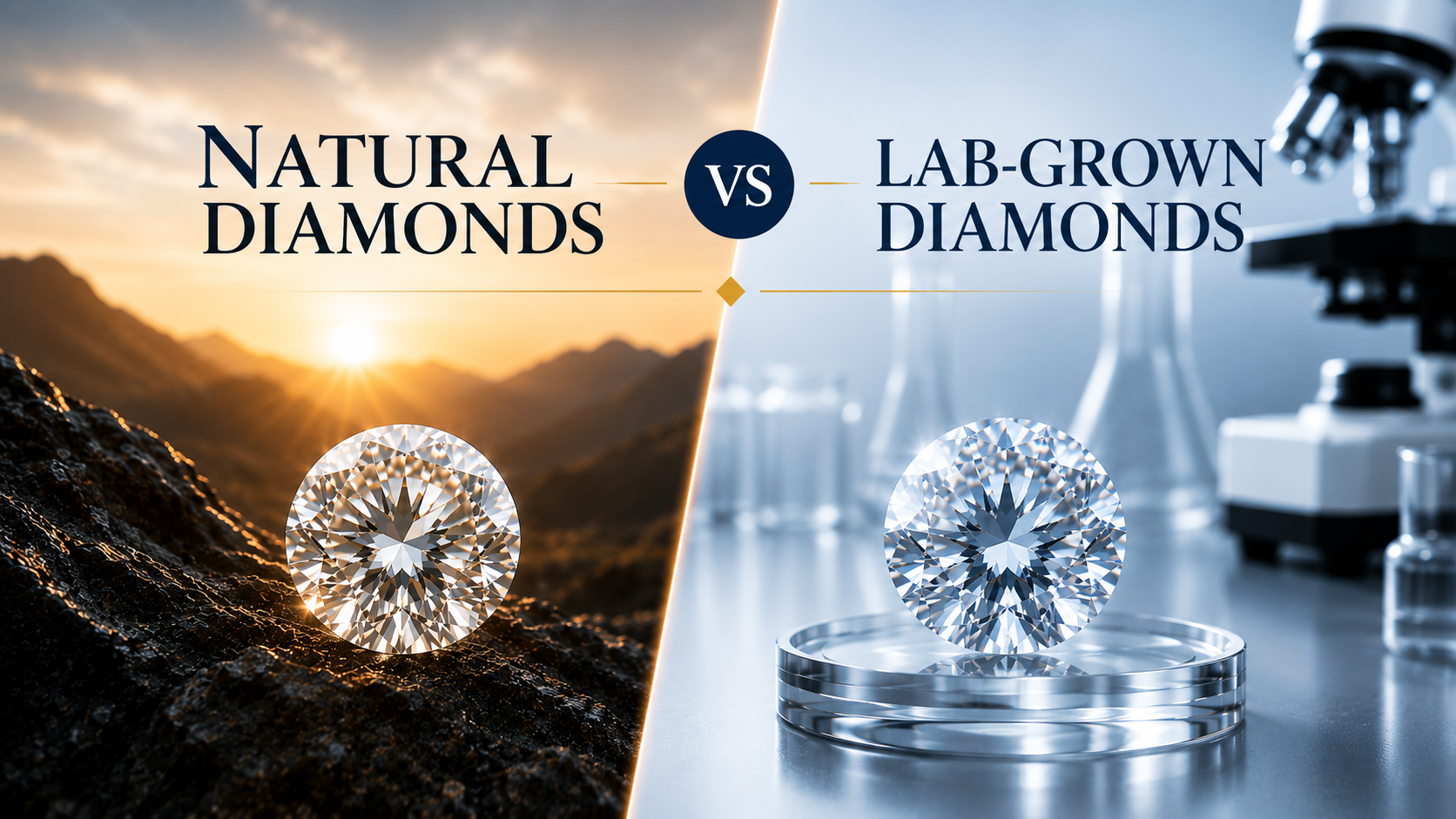
Natural Diamonds VS Lab-Grown Diamonds: Which One Should You Buy?
Buying a diamond should not be only about its sparkles and cost. These days buyers have to pick between natural and lab-grown diamonds, and understanding how they differ can help to make a more informed choice. Both options are real diamonds, yet their nature, history, and other features are not the same. In this post, we will talk about the main differences between natural and lab-grown diamonds, such as quality, price, value, and sustainability, and what you need to consider when purchasing one in Switzerland.
What is a Natural Diamond?
Natural diamond is a stone that was created in the depth of the Earth under very high temperatures and pressures during millions or even billions of years. Carbon atoms gradually crystallize to form a structure that makes diamonds so hard and shiny. Rough natural diamonds then undergo sorting, cutting and polishing, after which they are sold to consumers.
Why People Choose Natural Diamonds?
There are several reasons why people choose natural diamonds. Among them are the natural origin, rarity, geological history, and tradition of natural diamonds. Many people find some sort of emotional value in the idea of a diamond forming naturally over so many years. Also, natural diamonds traditionally appeal to people as a classic and timeless item and are often used for engagement rings and other items of inheritance.
What is a Lab-Grown Diamond?
Lab-grown diamond is an artificial diamond that is grown in a lab instead of forming naturally in the depths of the Earth. It is grown artificially using special technologies that create proper conditions for the creation of diamonds. Such diamonds have all the same chemical, physical, and optical characteristics as natural diamonds.
How Are Lab-Grown Diamonds Created?
There are two primary ways that diamonds can be grown. The first one is called HPHT (High Pressure High Temperature), while the second one is Chemical Vapor Deposition or CVD. Both of these approaches use either high pressure and temperature or gases in a controlled setting to create diamond material. Gem-grade diamonds can be grown with both of these approaches.
Are Lab-Grown Diamonds Real Diamonds?
Yes. Lab-grown diamonds are not diamond simulants. They cannot be confused with materials like cubic zirconia or moissanite, which might appear similar but have completely different chemical composition and physical properties. Lab-grown diamonds, on the other hand, are real diamonds in all respects except for how they are created.
Lab-Grown Diamond VS Natural Diamond: Differences
The biggest difference is the way the diamond is formed. Natural diamonds form naturally in the Earth, while lab-grown diamonds are created with the help of technology.
|
Feature |
Natural Diamond |
Lab-Grown Diamond |
|
Origin |
Formed naturally inside the Earth |
Grown in a laboratory |
|
Formation time |
Millions or billions of years |
Produced on a much shorter timescale |
|
Material |
Diamond |
Diamond |
|
Appearance |
Diamond brilliance and sparkle |
Diamond brilliance and sparkle |
|
Growth methods |
Natural geological processes |
HPHT or CVD |
|
Rarity |
Naturally scarce |
Produced through controlled manufacturing |
|
Price |
Generally higher for comparable stones |
Generally lower for comparable stones |
|
Identification |
Can be identified through gemological testing |
Can be identified through specialised testing |
In other words, it does not say what kind of stone it is but informs about the place and way the diamond was grown. There is a professional gemological testing which allows distinguishing natural and laboratory-grown diamonds by some features which they have.
Natural vs. Lab-Grown Diamonds: Quality Comparison
When buying a diamond, one should pay attention not only to whether the stone is natural or lab-grown but its quality too. It is evaluated with the help of certain features which include cut, color, clarity, and carat weight among others.
Cut
Cut means the quality of polishing and shaping the stone in order to make it shine. In case of well-cut diamonds, there are many sparkling facets. Thus, one should not think that one kind of diamond is always more brilliant than another one without checking cut quality.
Color
Color means the amount of color which can be seen in the diamond. For example, for traditional colourless diamonds, smaller body color means better grade. It is worth remembering about the fact that both cut and clarity should be checked when comparing two diamonds.
Clarity
Clarity means inclusions and blemishes which the stone has. Diamonds can have these clarity characteristics whatever origin they are. These characteristics should be professionally graded according to recognized grading standards.
Carat
Carat is the weight of the stone not its size. Diamonds of the same carat weight can have different appearance depending on the shape, proportionality, and cut of diamonds.
Can You Tell the Difference Between Natural and Lab-Grown Diamonds?
It is extremely difficult for an ordinary person to distinguish a natural diamond from a lab-grown diamond. Diamonds have a similar appearance and optical properties. Their different origins are reflected in some features of diamonds which can be detected with the help of special gemological equipment.
According to GIA, there is no possibility of distinguishing some types of natural diamonds from laboratory-grown diamonds with the help of traditional observations and usual diamond detectors.
That is one of the reasons for buying certified diamonds with proper disclosure of origin.
Natural Diamonds vs. Lab-Grown Diamonds – Price
Price is frequently the most influential criterion. Comparable lab-grown diamonds are often less expensive compared to natural diamonds, which can make buyers' jewellery budget planning easier.
Why Do Lab-Grown Diamonds Cost Less?
Natural diamonds are rare, and their formation process is geological. Natural diamonds need to be explored and mined. Lab-grown diamonds can be produced using manufacturing technologies. Differences in supply and production affect pricing of diamonds.
Diamonds have very different prices. Price depends on many factors including diamond's carat weight, cut, colour, clarity, certification, design, craftsmanship and others.
Higher Price Means Better Quality, Right?
Not always. Higher price doesn't mean that diamond is going to be more beautiful or will suit better. Buyer should compare cut, colour, clarity, carat, certification and general appearance of the diamond and not just take into account the price.
Which Is More Valuable Over Time?
Long-term value cannot be measured only by comparison of the price at the time of purchase and price when jewellery is resold. Resale value depends on a number of factors including market demand, supply, diamond characteristics, certification, state of jewellery, brand, place of sale, and other factors.
In case resale value is the main concern of the buyer, it is better to discuss market and concrete diamond with a jeweler. In general, diamond should be purchased not as an investment but as beautiful stone with special meaning and meaning.
Natural Diamonds vs. Lab-Grown Diamonds and Sustainability
Sustainability is becoming a more important issue for modern buyers. However, it is important to look beyond "sustainable" or "eco-friendly" labels.
Natural diamonds imply mining and problems associated with extraction and processing of natural resource. Lab-grown diamonds don't require traditional mining but use laboratory production which requires energy consumption, and it can vary depending on the source of energy.
For the buyers interested in sustainability it is recommended to ask jewelry companies about the details of diamond origin, sourcing, production, traceability, and documentation.
Which Diamond Is Better for an Engagement Ring?
There is no universally better choice when selecting an engagement ring diamond.
Natural diamonds will be a better choice if you appreciate the authenticity, rarity, geological history, symbolism and the opportunity to own a stone which was created by nature over thousands of years.
If you prefer a real diamond but care more about the cost of a stone, its size within a particular budget or lab grown nature then the lab grown diamond will be your choice.
But the main point is not to select the diamond based on what people say. Select the one which fits your values and the concept of your engagement ring.
How to Choose Between Natural and Lab Grown Diamonds
To understand which type is better for you ask yourself some questions before making a choice:
-
Does the natural origin of a diamond mean anything to me?
-
What is my jewellery budget?
-
Would I prefer the bigger stone within the budget?
-
Are the rarity and geological history important?
-
Does the sustainability and production process affect my choice?
-
Am I buying it just for the emotional value and beauty?
-
Do I have the certified diamond report?
-
Did I compare the cut, color, clarity, and carats of the stones?
-
Once you define the criteria, the selection process will become much easier.
-
Buying a Diamond in Switzerland: What Should You Check?
If you plan on buying a diamond in Switzerland, you need to consider the following factors: transparency of the store, certification, quality, and services. Ask whether the diamond is natural or artificial and look at the grading certificate to make sure that all features of the stone are known to you.
Checking the quality of the setting, craftsmanship, possibility to adjust the size of the jewel, warranty and after-sales service can be also helpful if you are planning on buying engagement ring or other expensive diamond jewel.
Questions to Ask Your Jeweller Before Buying
Before purchasing a diamond, consider asking:
-
Is the diamond natural or laboratory-grown?
-
Does it come with an independent grading report?
-
What are its cut, colour, clarity, and carat characteristics?
-
Can the grading report be verified?
-
Has the diamond undergone any treatment?
-
What is included in the jewellery price?
-
What warranty and after-sales services are provided?
-
Can the ring be resized if necessary?
-
What care does the jewellery require?
-
Can you explain why this particular diamond is recommended for my budget?
A transparent jeweller should be comfortable answering these questions and helping you understand the purchase before you make a decision.

Natural vs. Lab-Grown Diamonds: Quick Decision Guide
|
If you prioritise... |
You may prefer... |
|
Natural origin |
Natural diamond |
|
Geological history |
Natural diamond |
|
Traditional appeal |
Natural diamond |
|
Lower upfront price |
Lab-grown diamond |
|
More size within a set budget |
Lab-grown diamond may offer more options |
|
Laboratory-grown origin |
Lab-grown diamond |
|
Personal rarity and heirloom appeal |
Natural diamond |
This is a guide, not a rule. The best choice depends on your individual priorities.
Final Verdict: What Should You Choose?
Ultimately, the question of whether to pick a natural diamond or a lab grown one boils down to preference and priorities. Natural diamonds present a unique geological background and rarity, whereas a lab grown diamond can be a different option for purchasing a real diamond with a laboratory background and reduced pricing when compared.
Instead of debating which diamond is best in all cases, you should determine which diamond is best for you. Make a comparison of quality, certification, price, origin, and other factors.
Frequently Asked Questions
Are lab-created diamonds real diamonds?
Yes, lab-created diamonds are authentic diamonds and have the same chemical, physical, and optical properties as diamonds.
What is the major difference between diamonds that occur in nature and lab-created diamonds?
The primary difference is that natural diamonds are grown in nature while lab-created diamonds are grown under lab conditions.
Are lab-created diamonds more affordable than diamonds that occur in nature?
In most cases, yes, lab-created diamonds are more affordable than natural diamonds.
Is there any way to distinguish these two types of diamonds without testing them?
No, natural and lab-created diamonds can be indistinguishable just by looking at them.
Which is better to wear in an engagement ring?
It depends on many factors including personal preferences and budget restrictions.


Leave a comment
This site is protected by hCaptcha and the hCaptcha Privacy Policy and Terms of Service apply.